
Every matchup, scored for you.
The Matchup Detector takes a posted prop and scores the matchup behind it from 0 to 100. The score becomes a grade, A+ down to F.
Every input is on the card. Where the line moves from player to player, the grade is the posted line measured against the engine’s projection for him, and that projection is on the card too.
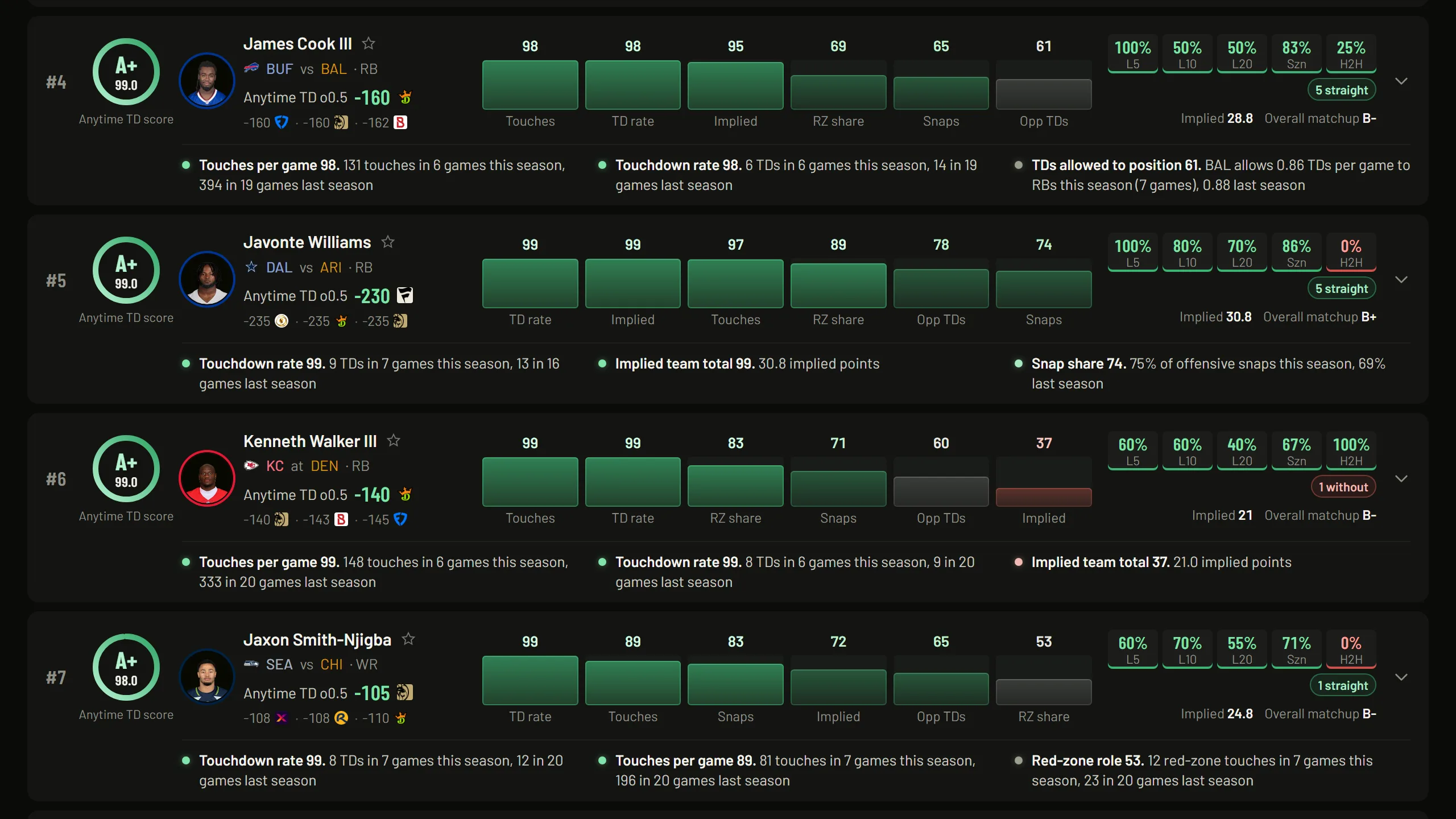
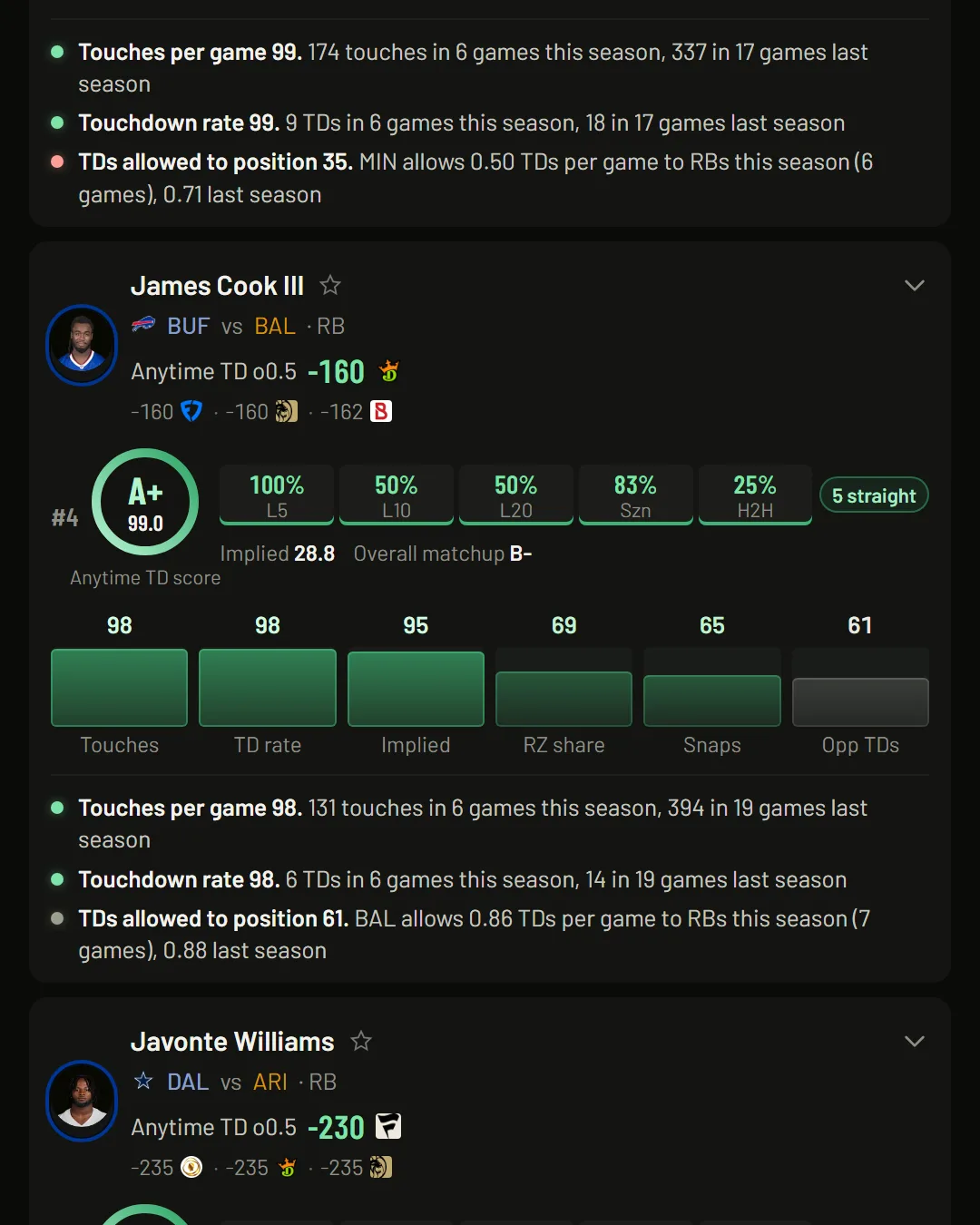
A+James Cook III to score, Ravens at Bills
99.0his score, from six factors
What’s on a card
The grade and its score sit in a ring. Next to it is one bar per factor, each scored 0 to 100 against this season’s league, strongest first. Open the card and every factor is written out in a sentence.
Below that is his real record at this line: the hit rate over the last 5, 10 and 20, the season and head to head, and his current streak. Then the best over price at your books, with a few others beside it.
James Cook III to score, Ravens at Bills: A+, 99.0, from six factors. Touches 98, on 131 in 6 games. Touchdown rate 98, on 6 in 6 games. Baltimore was allowing 0.86 touchdowns a game to running backs.
Where the grade comes from
From the same stats the rest of the site shows. For a home run prop that’s hard-hit rate, barrels, the park and the starter he’s facing. For a touchdown it’s touches, snaps, red-zone share and what the defense gives up.
Some lines change from player to player: strikeouts, outs, yards, receptions, saves and the basketball counts. On those the engine makes a projection for the player tonight, and the grade is how the posted line sits against it, ranked against every spot the engine was calibrated on. The card prints the projection beside the line, with his own norm next to it.
A market with a set line, like a home run, a hit or an anytime touchdown, has no number to project. There the score is where tonight’s setup ranks among the games the engine was calibrated on.
The price rides along for comparison. It never feeds the grade.
What a grade doesn’t say
A grade describes a matchup. It doesn’t call the result, and nothing on the page is a recommendation.
A line set a full spread under a player’s norm gets a flag on the card: “Line well under his norm”, with a prompt to check for a workload note. His norm is printed beside the line, so the gap is there to read.
The page opens on B and better. Widen the grade filter to see everyone.
The markets it covers
| Sport | Graded markets |
|---|---|
| MLB | Home runs, hits, total bases, RBI, runs, hits + runs + RBI, pitcher strikeouts, pitcher outs |
| NFL | Anytime touchdown, passing yards, rushing yards, receiving yards, receptions |
| NBA | Points, rebounds, assists, threes, the four combos, blocks, steals, turnovers |
| WNBA | Points, rebounds, assists, threes, the four combos |
| NHL | Shots on goal, points, anytime goal, assists, power-play points, blocked shots, saves |
| Soccer | Anytime goal, shots on target, shots, assists, to be carded |
A market that isn’t in the table has no grade.
What’s free
A free account sees the grades for the free game’s players, and a count of how many more were scored on the slate.
The rest of the slate is $19.99 a month plus applicable tax. One plan covers every sport.
21+ only. Gambling involves risk. Never bet more than you can afford to lose. If you or someone you know has a gambling problem, call 1-800-GAMBLER.